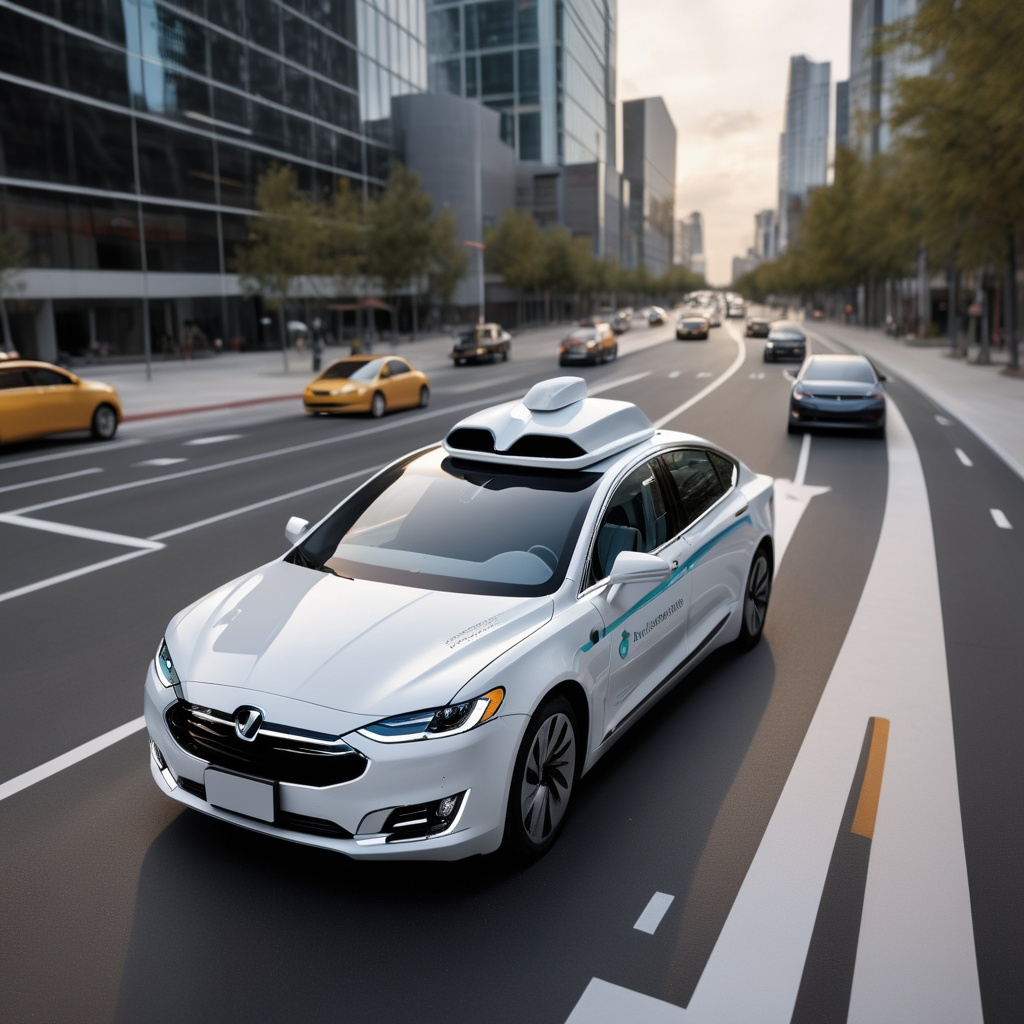
The autonomous vehicle, better known as the self-driving car, is one of the latest applications of artificial intelligence to transport. Such vehicles hold immense potential: they could drastically change the automotive industry and reform the way people commute, work, and go about their surroundings. The technology for self-driving requires highly advanced artificial intelligence systems that shall be able to sense the environment and make real-time decisions, commanding the vehicle with little to no human input. The article talks about how AI does or will contribute in the development of autonomous vehicles, what the technology behind such autonomous navigation is, and how self-driving cars might change the world.
Levels of Autonomy in Self-Driving Cars
The Society of Automotive Engineers has come forth to define six levels of vehicle autonomy starting from Level 0 (No Automation) to Level 5: Full Automation. These said levels will help explain how essential AI is in driving an autonomous vehicle:
Level 0 - No Automation: The driver is in full control of the vehicle without any support from the system. Level 1 - Driver Assistance: Features such as adaptive cruise control or lane-keeping assist may actively support the driver, who is still in complete responsibility. Level 2 - Partial Automation: The vehicle may become able to perform either steering or acceleration simultaneously, but under any circumstances, the driver has to be engaged and ready to take full control.
Level 3: The vehicle controls all aspects of driving under specific conditions and may require the driver to take control over the vehicle when so prompted. Level 4: The vehicle would be able to move itself without human intervention in the majority of driving situations, though it may not be able to operate during complex environments or in extreme weather. Level 5: This is considered full autonomy; the vehicle can handle any kind of environment and condition without any human input whatsoever.
Artificial Intelligence helps achieve higher levels of autonomy, especially Levels 3 through 5, which require real-time decisions on any given situation or a detailed environment analysis.
Core Technologies Behind Autonomous Vehicles
Development in the case of autonomous vehicles puts several advanced technologies together. At its core, AI, more specifically machine learning/deep learning algorithms, works to process reams of data from various sensors and arrive at intelligent decisions. Some of the key components of the technology stack behind autonomous vehicles are given below:
1. Sensors and Perception Systems
Consequently, autonomous cars use a suite of sensors to provide an accurate perception of their environment. These include:
LiDAR: Light Detection and Ranging - LiDAR relies on the laser pulse for developing a three-dimensional map of the surroundings in minute detail. In this respect, LiDAR becomes an indispensable component in obstacle detection, lane markings identification, and distance estimation with respect to surrounding objects. LiDAR is highly valued in autonomous systems due to its accuracy and, moreover, low-light operation, though it still remains a very expensive component.
Cameras will provide visual information much as the input to humans from driving. It captures still images and videos of the environment, which enables AI systems to recognize road signs, traffic lights, pedestrians, and other vehicles. Cameras work in conjunction with deep learning algorithms and help in visual cues for making decisions that are appropriate in any given circumstances.
These setups use radar systems to measure the velocity and distance of objects surrounding the vehicle. They work exceptionally well in tracking the movement of other vehicles and can operate in harsh weather conditions, such as rain or fog, which makes them a critical complement to cameras and LiDAR.
Ultrasonic Sensors: These types of sensors are usually used for low-range detection, in parking situations or when navigating through tight spaces. They provide data on close objects that may be too close to be reliably detected by LiDAR or cameras.
All of this information from these sensors is put together through sensor fusion techniques in the AI system to create a broad, real-time view of the vehicle's surroundings. Sensor fusion thus allows the vehicle to understand complex driving scenarios and detect potential hazards, such as pedestrians crossing the road or traffic merging.
2. Localization and Mapping
An autonomous vehicle is able to travel safely only when it knows its precise position and the geometry of the road. It requires a complicated set of localization and mapping systems that include the following:
GPS: The poor accuracy means that it can only provide the general position. Hence, GPS information will be used by the AI algorithms together with other sensors in order to increase the accuracy of the vehicle's location.
HD Maps: HD maps paint in all the details, such as lane markings, traffic signs, and changes in elevation, along the road that an autonomous vehicle may use. These maps are necessary to enable navigation with accuracy and, therefore, must be updated with real-world conditions. AI systems combine HD maps with sensor data to keep an accurate and dynamic model of the driving environment.
SLAM: SLAM is a technology that helps the vehicle create a map of its surroundings while concurrently calculating its position inside the map. This would be very useful in cases where GPS signals become weak or completely lost, say, in tunnels or urban canyons. AI-powered SLAM systems create a 3D model of their surroundings using data from LiDAR, radar, and cameras that enable localization even in challenging conditions.
3. Path Planning and Decision Making
After the perception of the environment and establishing the position of the vehicle, the AI systems must plan a path for the vehicle and make appropriate decisions based on prevailing traffic conditions, road rules, and potential obstacles. It involves:
Trajectory Planning: AI algorithms will compute the optimum route to be pursued by the vehicle, keeping in view the speed limits, curvature in the road trajectory, and the density of other vehicles. In real driving, the system should constantly update its trajectory; indeed, this may be dictated by real-world evolving conditions, such as the entry of a pedestrian into the road or sudden congestion.
Decision-making models: In combination with deep neural networks, reinforcement learning allows autonomous cars to determine what to do in any complicated situation on the fly. Such models study information from sensors and make a choice about what to do. The choice may be to slow down, change the lane, or stop at a traffic light. Decisions have to be made in such a way that the balance between safety, efficiency, and comfort is maintained-the vehicle doesn't violate traffic laws and is able to provide a smooth ride to passengers.
Obstacle Avoidance: AI-powered obstacle detection systems will help the vehicle to identify and avoid obstacles such as debris on roads, cyclists, or animals. It predicts the obstacles based on their behavior and changes the course of the vehicle in order to avoid a collision.
4. Control Systems
The control system, which is the last stage in autonomous navigation, carries out proper execution of the planned route and actions as set out by AI. Control systems operate with variables like steering, acceleration, and braking. Advanced algorithms, such as Model Predictive Control, optimize these actions to make driving smooth and safe. The AI oversees, second by second, how the vehicle operates and makes adjustments toward accuracy, stability, and safety.
Role of AI in Training Autonomous Vehicles
The role of artificial intelligence in autonomous vehicles is not restricted to making split-second decisions in real time but also plays an important role in the development and training processes of self-driving technology. The most common machine learning models used in self-driving cars are the kinds that get trained from large volumes of data collected from real on-road driving situations. That includes images, videos, sensor readings, and telemetry data-essentially all types of scenarios an AI system should have in its dataset.
Companies try to hasten this process of learning by using simulated environments where self-driving algorithms can practice driving with no physical risks. Simulations can create complex traffic patterns, various weather conditions, and even emergency scenarios-all providing extremely useful training data which may be so hard or dangerous to collect on real roads.
While reinforcement learning allows systems to independently learn through trial-and-error so that decision-making algorithms optimize based on rewards and penalties. For example, the AI can get rewarded for keeping distance from other cars and penalized for irregular lane changes. All in all, over time, the system will enhance its capability of driving safely and efficiently.
Challenges and the Future of Autonomous Vehicles
While autonomous vehicles continue to make rapid strides in technological terms, there are a number of challenges that persist, including:
Safety and Reliability: These are major concerns because, for their actualization, autonomous vehicles would have to operate safely under all conditions, whether it be adverse weather or a complex urban environment. AI systems need to attain a very high degree of reliability before large-scale deployment can occur.
Ethical and legal issues consist of AI-powered decision-making, such as how autonomous vehicles should act when there is an unavoidable accident. The development of legal frameworks aiming at liability and regulation questions regarding self-driving cars is also in full swing.
HD maps have heavy infrastructure and data needs, which should be highly accurate and current. On the other hand, V2I and V2V also require reliable communication networks. Infrastructure development and its maintenance are one of those overheads, which are seriously cumbersome and expensive.
With these challenges, the future of autonomous vehicles does look bright. Continuous improvements in AI, sensor technology, and infrastructural development may just make self-driving cars a common and affordable reality. Already, companies like Tesla, Waymo, and General Motors are conducting extensive tests of Level 4 and Level 5 vehicles, and it could be conceivable that it is truly going to be an autonomous future.
Conclusion
Autonomous vehicles represent one of those rarities: an unprecedented marriage of AI with automotive. By integrating sensor information, deep learning, and complex algorithms, AI empowers self-driving cars to recognize, interpret, and traverse dense environments with incredible precision and a minimum level of human error. Yet considerable challenges remain, with huge potential for its application in making safety, traffic flow, and changing the way cities move people. And with continued refinement in research and development, AI-driven autonomous vehicles will change the face of transportation to come.