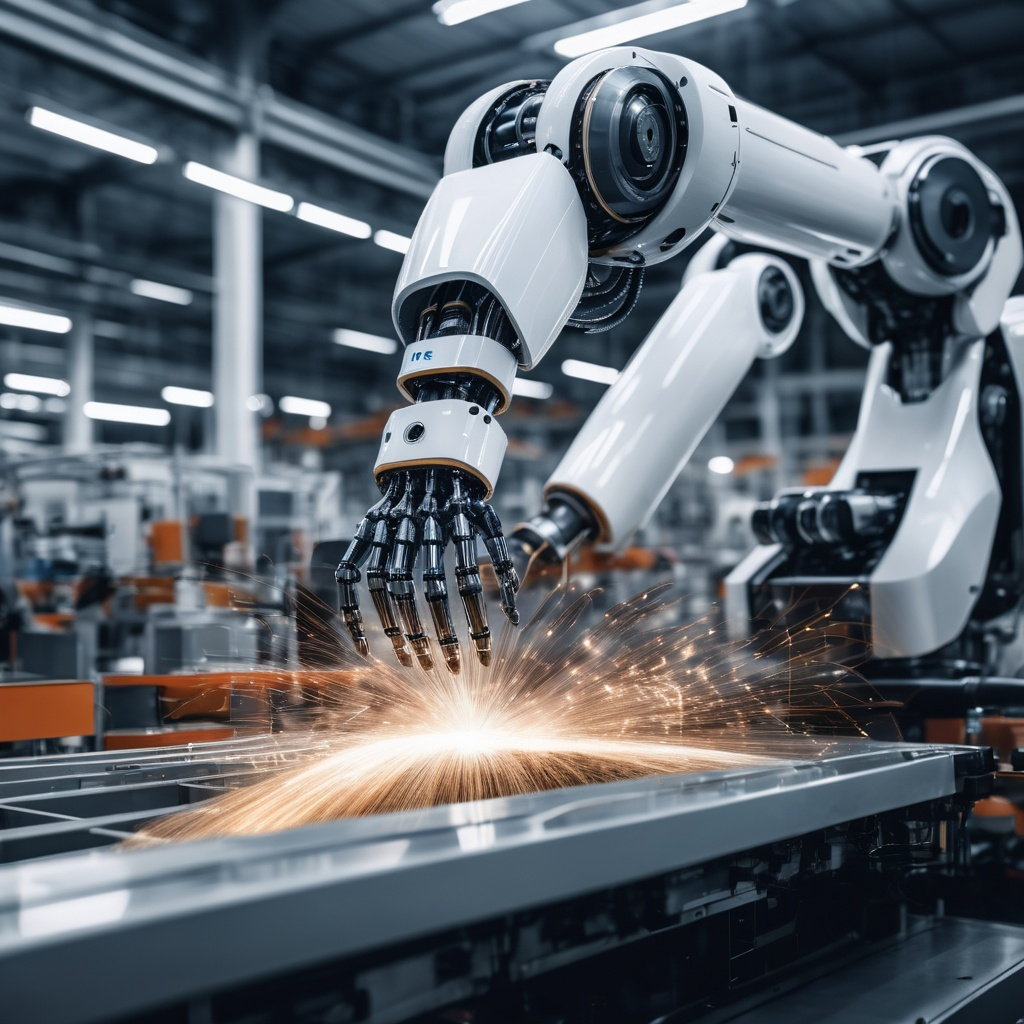
Artificial intelligence means a revolution to manufacturing industries in terms of efficiency and productivity by saving costs while automating and optimizing processes. AI-powered systems analyze huge sets of data, predict maintenance needs, improve product quality, and drive decision-making at unprecedented speeds. As the manufacturing world is moving into Industry 4.0, AI leads the pack by realizing smart factories for better efficiencies and more sustainable operations. This article examines how AI is revolutionizing manufacturing; the numerous applications and benefits accruing from the technology; the challenges associated with its implementation, and what the future holds for AI in this key sector.
1. The Rise of AI in Manufacturing
AI has now become the backbone of modern manufacturing, facilitating movement toward smart factories that are embedded with intelligent machines, IoT devices, and advanced analytics. With an ever-growing urge by manufacturers to be at the leading edge in the competitive global market, AI technologies are helping them put a cap on productivity by reducing downtime while optimizing operations.
Industry 4.0, a more colloquial term for the fourth industrial revolution, represents the fusion of digital technologies into manufacturing. The backbone of this smart manufacturing features AI combined with other technologies involving IoT, robotics, and cloud computing. With this approach, the machinery and the systems communicate, share information, and can make their decisions.
2. AI Applications in Manufacturing
It finds its application in every stage, starting from design to production, quality checking, and even supply chain management. Some of the most influencing usages of AI within manufacturing are as follows:
a. Predictive Maintenance
Predictive maintenance is easily among the most valuable uses of AI in manufacturing. Traditionally, schedules for maintenance could either be reactive-a machine gets fixed after it fails-or preventive-periodic checks, irrespective of condition. Both methods have quite a share of losing time and resources in less-than-efficient ways.
AI revolutionizes this process by offering predictive maintenance where machine learning models analyze data emanating from sensors attached to the equipment for temperature, vibration, and pressure. By tracking patterns and anomalies, AI is capable of estimating when a given machine is likely to fail or call for servicing, hence allowing the manufacturer to perform maintenance only at the right time. This reduces unplanned downtime, prolongs the life of equipment, and lowers costs related to any form of maintenance.
b. Quality Control and Inspection
AI-driven quality control systems raise the bar in product inspection by leveraging computer vision and machine learning algorithms to detect defects and inconsistencies in real time. Traditional quality control involves manual inspections or rule-based systems, which are much slower and prone to delivering errors.
AI-based inspection systems have high-resolution cameras with image recognition technologies that analyze products moving on a production line. These detect defects-scratches, deformed shapes, or wrongly assembled-with greater speed and accuracy compared to human inspection. This is because AI continually works out the best means to enhance its accuracy over time in ensuring quality in products while reducing waste and rework.
c) Process Optimization
Manufacturing processes are inherently complex, involving several stages and variables. AI works out an optimum path in these processes through the analysis of production data and offers recommendations on various opportunities for efficiency improvement. Manufacturers can simulate scenarios to define strategies for throughput increase, waste reduction, and energy efficiency using machine learning models.
These are algorithms in AI that may even regulate the machine parameters in real time to come up with some form of optimization in production, considering factors such as material availability, energy costs, and fluctuations in demand. This dynamic optimization leads to better resource management, more efficient production cycles, and ultimately, increased profitability.
d. Robotics and Automation
AI robotics and automation are revolutionizing the lines, making them much faster, safer, and more flexible. Equipped with AI, collaborative robots-or cobots-work alongside human workers to handle repetitive or hazardous tasks-welding, packaging, and material handling. These cobots are designed to learn from their environment for adapting to new tasks; hence, they can be versatile and vital for modern manufacturing.
AI also supplies the power of robotics in assembly automation. Using AI algorithms, robots locate parts, move with precision, and assemble products-mostly with no human intervention. Such systems are very crucial to industries like electronic and automotive manufacturing, where precision and speed mean everything. As AI continues to improve, so will these robotic systems' abilities, allowing for more automation and flexibility.
e. Supply Chain Optimization
AI has already become an indispensable part in the modern era that optimizes the supply chain to have what a manufacturer needs at exactly the right time, without holding too much costly inventory. AI analyzes data from suppliers, production systems, and market trends with accurate forecast demands thanks to AI-optimized inventory management. That is how materials are available when needed just in time for production, minimizing storage costs, thereby reducing the risk of a stockout position or overproduction.
AI also helps in understanding the bottlenecks within the supply chain and provides solutions on how such can be prioritized for logistics optimization. For example, AI can work out the most efficient delivery routes for raw materials, thus reducing costs of transport and carbon dioxide emission. It can also forecast potential disruption-say, delays by suppliers or alteration in demand patterns-which would give the manufacturers a chance to review their strategies in advance.
f. Product Design and Customization
AI is an increasingly important contributor in the design phase, with the drive to develop innovative and effective product designs. This is because generative design software, powered through AI, allows engineers to set design goals and constraints, such as weight limits or materials. In turn, the algorithm develops an unlimited number of alternatives for design. And often, it produces creative solutions that human designers may not think of.
Finally, AI has made it possible to perform mass customization, in which manufacturers are able to efficiently create personalized goods. AI systems interpret the preference analyses of customers and dynamically change production parameters in a way that each product meets individual specification without giving away anything to the speed and quality of the production. This potential of AI is beneficial to industries such as the automobile industry and consumer electronics, where the trend of personalization is on the rise.
3. Benefits of AI in Manufacturing
The use of AI within manufacturing has several advantages, including enhanced productivity, cost cuts, assurance of worker safety, and improvement in the quality of a product. Now, let's take a closer look at some of these advantages of AI in manufacturing:
a. Efficiency and Productivity
AI automates the routine and repetitive tasks, hence not requiring much intervention of humans. Productivity, therefore, becomes higher. For example, with the AI performing tasks related to predictive maintenance and quality control, production lines will get smoother, and resources will be utilized in a much better way. The process is further optimized by AI, dynamically adjusting parameters to achieve the objective of peak efficiency for production lines.
b. Cost Reduction
It does this by minimizing costs in many aspects, including: conducting predictive maintenance and hence reducing any occurrences of downtime and its associated costs; optimizing energy usage, very important in manufacturing as it can be quite energy-intensive; replacing labor costs through AI-driven automation that accomplishes tasks that would otherwise have been performed by human employees. Additionally, AI improves the quality of the products. This is especially true because it will minimize wastes caused by defects and reduce reworks. The advantages of AI are threefold.
c. Improved Quality of Products
Because of the real-time monitoring of the production process, detection of defects, AI would result in quality products. Continuously improved machine learning processes make inspection and quality control more accurate with time as defects and waste will be reduced. All that leads to improvements in product quality and supplies better customer satisfaction regarding brand reputation.
d) Improved Safety
AI makes workspaces safer since hazardous tasks are now automated and therefore do not require human workers. Examples are handling toxic substances, manipulating heavy machinery, or working under extremely low or high temperatures. Cobots support human labor by taking up heavy work and repetitive operations on their own, which reduces injuries. AI-powered monitoring systems could also detect safety risks in real-time and alert supervisors for immediate intervention.
4. Challenges of Implementing AI in Manufacturing
While AI holds a lot of advantages, their implementation in industries does not come without issues. The challenges that the manufacturers will have to face are several: technical, financial, and ethical problems to be cleared for better functionalities of AI.
a. High Initial Investment
Advanced robotics use in integration with predictive maintenance systems or IoT sensors, requires a whole bunch of upfront investment in AI technologies. Quite a few of the small manufacturers would lack the money and technical whiz to adopt AI solutions. In most scenarios, the long-term benefits become justifying factors for such an investment, but the companies need to make proper planning related to AI implementation to ensure that this results in a decent return on investment.
b. Data Management and Security
AI systems need volumes of data to operate efficiently. The companies face the burden of collecting, storing, and processing large volumes of data emanating from machines, sensors, and other sources. Ensuring that data is accurate, consistent, and well-protected should be paramount for the right performance of AI. Data breach or inaccuracy can compromise an AI system, setting production errors or even a cyber threat. In this regard, manufacturers have to institute rigid data management and cybersecurity against sensitive information to maintain the integrity of AI systems.
c. Skills Gap
Most manufacturing workers usually lack the skills necessary for implementing AI and therefore require a workforce that has practical expertise in the development of AI, data science, and systems integration. Therefore, there is a lack of proper skills among many of the traditional workers in manufacturing, and that constitutes the reason for the gap in their skills. Manufacturers need upskilling and reskilling programs to teach employees how to work with AI technologies. Collaboration with educational institutions and technology providers might bridge this gap and ensure a seamless transition into AI-enabled manufacturing.
d. Ethical and Workforce Implications
Automation of manufacturing by means of AI raises a number of ethical questions, particularly with respect to the impact on employment. Whereas new job opportunities may emerge in areas related to the operation, maintenance, and development of AI systems, many traditional manufacturing jobs are lost. Such decisions need to be balanced with consideration for social and economic stability.
5. The Future of AI in Manufacturing
The future of AI in manufacturing appears to be bright with continuous development and new applications that come their way. Following are some key trends and development that shall mark the future of AI in the manufacturing sector:
a. Autonomous Factories
The very concept of a completely autonomous factory-one where an AI system manages every little detail of production without human interference-is reality. Such factories will employ AI in carrying out tasks ranging from material handling and assembling through quality checking to performing routine maintenance. Autonomous factories will be able to operate 24/7 with minimum downtimes, pushing efficiency and output.
b) AI-Driven Sustainability
AI plays an important role in making manufacturing more sustainable. It would optimize energy use, reduce waste, and lower emissions to enable manufacturers to meet their sustainability objectives. AI-powered systems will also improve recycling processes that will efficiently sort and repurpose materials.
c. Integration with 5G and Edge Computing
This will be further enhanced in manufacturing with the deployment of 5G networks combined with edge computing technology. With its low latency and high data transfer rates, 5G will enable AI systems to process information in almost real time, so responsiveness and decision-making will be further improved. Similarly, edge computing-data processing closer to the source-reduces the need for centralized data processing and thus makes AI applications much more efficient and scalable.
d. Human-AI Collaboration
While automation will continue to expand, the collaboration of humans and AI will, in turn, become more vital. AI will then help the workers by offering real-time insights, optimizing workflows, and conducting dangerous or repetitive tasks. This approach lets humans engage more in complex, value-added activities where their full skills and talents can be focused, thus allowing humans to become more productive and job-satisfied.
Conclusion
AI is a game-changing force for good in manufacturing, driving unparalleled efficiency, productivity, and quality. Starting with predictive maintenance and quality control, ending with process optimization and supply chain management, AI applications literally improve everything. Though challenges such as high initial investment, data security, and workforce implications are still present, potential benefits of AI outweigh these obstacles. As more manufacturers continue to adopt and integrate AI technologies, the industry will shift toward even more autonomous, efficient, and sustainable methods of production and help shape the future of manufacturing in the era of digitization.